
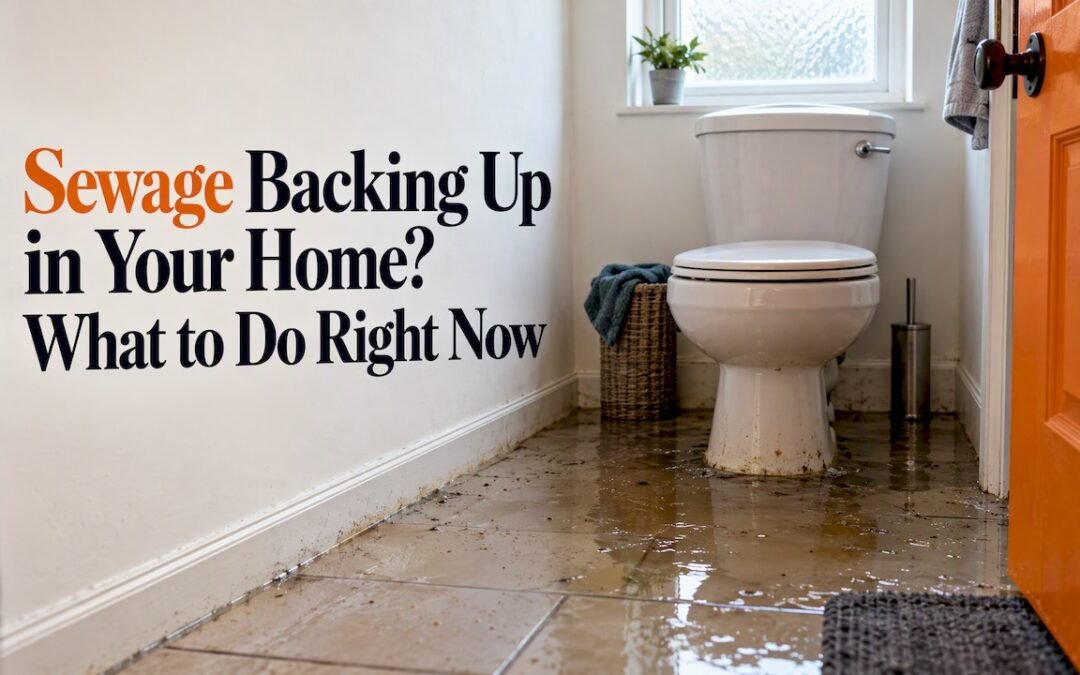
If sewage is coming back up through a toilet, drain or manhole, keep everyone away from it, switch off the electricity if water is near sockets or appliances, and stop using water in the property. Then find out whether the blockage is in your own drain or the public sewer, and call the right people. Sewer flooding is a job for professionals, not a mop and bucket. This guide covers what to do in the first hour, why it happens, who pays and what to do afterward. It is written from the point of view of a Coventry drainage company that clears these problems every week.
TL;DR
- Get people and pets away from the sewage, turn off the electricity and stop using water, including flushing toilets.
- Early signs are a toilet that will not flush properly, slow-draining sinks and baths, and a smell from the drains.
- Most backups come from a blockage (wipes, fat, roots, collapsed pipe). Heavy rain and groundwater can overwhelm sewers too.
- Who clears it depends on where the blockage sits. A CCTV survey shows exactly where, so you call the right party once.
- Clean up with gloves, hot water and detergent after the source is cleared, and see your GP or NHS 111 if you feel unwell.
Table of Contents
- How to tell sewage is backing up
- What to do in the first hour
- Why sewage backs up
- Who is responsible: you or the water company?
- How a backup is found and cleared
- Cleaning up safely afterward
- Perspective: what we see on call-outs
- Need help with a backed-up drain in Coventry?
- Preventing it from happening again
- FAQ
- Sources
How to tell sewage is backing up
Backups rarely arrive without warning. The water companies list the same early signs: difficulty flushing a toilet, sinks or baths that empty very slowly, and a bad smell coming from drains.
In our experience there are a few patterns worth knowing:
- Gurgling or bubbling in a toilet or plughole when you run a washing machine or empty a bath. Air is being pushed back because water cannot get away.
- More than one fixture affected. One slow sink is usually a local trap blockage. A slow sink plus a toilet that rises when you flush points at the main drain.
- Water in the gully or manhole outside that does not drain, or an inspection chamber that is full to the brim.
- Smell without visible water. A persistent sewer smell inside or around the property often means a broken or partly blocked pipe.
If you see only one of these, you may have time to book a visit before it becomes an emergency. If wastewater is already on your floor, treat it as one.
What to do in the first hour
The order matters. Here is the sequence we would give a customer on the phone.
- Keep people and pets safe. Move children and animals out of the affected room. Sewer flooding can be dangerous and should be dealt with by professionals.
- Switch off the electricity if sewage is near sockets, appliances or the consumer unit. Do not wade through water to reach the fuse board. If you cannot reach it safely, call an electrician or your network operator.
- Stop using water. No flushing, no taps, no washing machine or dishwasher. Every liter you send down adds to what comes back up.
- Take photos of the affected areas, if it is safe. Thames Water suggests this, and it helps with any later insurance or compensation conversation.
- Report it. Contact your water company straight away to report the problem and ask for advice. In Coventry that is Severn Trent, and the city council’s flood page gives 0800 783 4444 and says they should be able to tell you whether a blockage is in a public or private sewer. Note the reference number they give you.
- Call a drainage engineer if you need the blockage cleared and the cause found quickly. If you are in Coventry, Nuneaton, Bedworth or Hinckley, that is our emergency call-out service.
During severe weather, expect delays. Response times may be longer when many properties are affected at once, so reporting early puts you ahead in the queue.
What not to do
- Do not pour bleach, drain cleaner or caustic chemicals down a backed-up drain. They rarely shift a serious blockage and add a hazard when you or an engineer have to work in the water.
- Do not use a plunger or rods on a main drain you cannot see. You can push a blockage deeper or damage an old pipe.
- Do not drink or cook with water you suspect is contaminated, and do not assume the mains is at fault. Drinking-water pipes are sealed and under pressure, so clean water flows out and contaminants do not get in, even if there is a leak.
Why sewage backs up
A backup means wastewater has nowhere to go and takes the easiest route, which is back up the pipe and out of the lowest fixture or gully. The causes fall into a handful of groups.
Blockages from what goes down the drain
The most common cause is the dullest. Severn Trent says that 75% of its sewer blockages are caused by wrong things being put down sinks or toilets, such as wet wipes, sanitary products, vegetable fats and cooking oils. Wipes labeled “flushable” are a regular offender. Fat cools in the pipe, sticks to the walls and gathers anything that passes, until the bore is nearly closed.
Tree roots and damaged pipes
Sewer pipes can be broken or damaged by tree roots and by soil movement caused by extreme freezing and thawing. Older clay pipes with joints every meter or so are the classic case. Roots find a tiny leak, grow into the pipe and form a net that catches paper and waste. Cracked, offset or collapsed sections cause the same effect from a different direction. If the same drain blocks again and again, suspect structure rather than bad luck. Our root removal service deals with roots in the line, and a camera survey shows whether the pipe underneath needs repair.
Heavy rain and groundwater
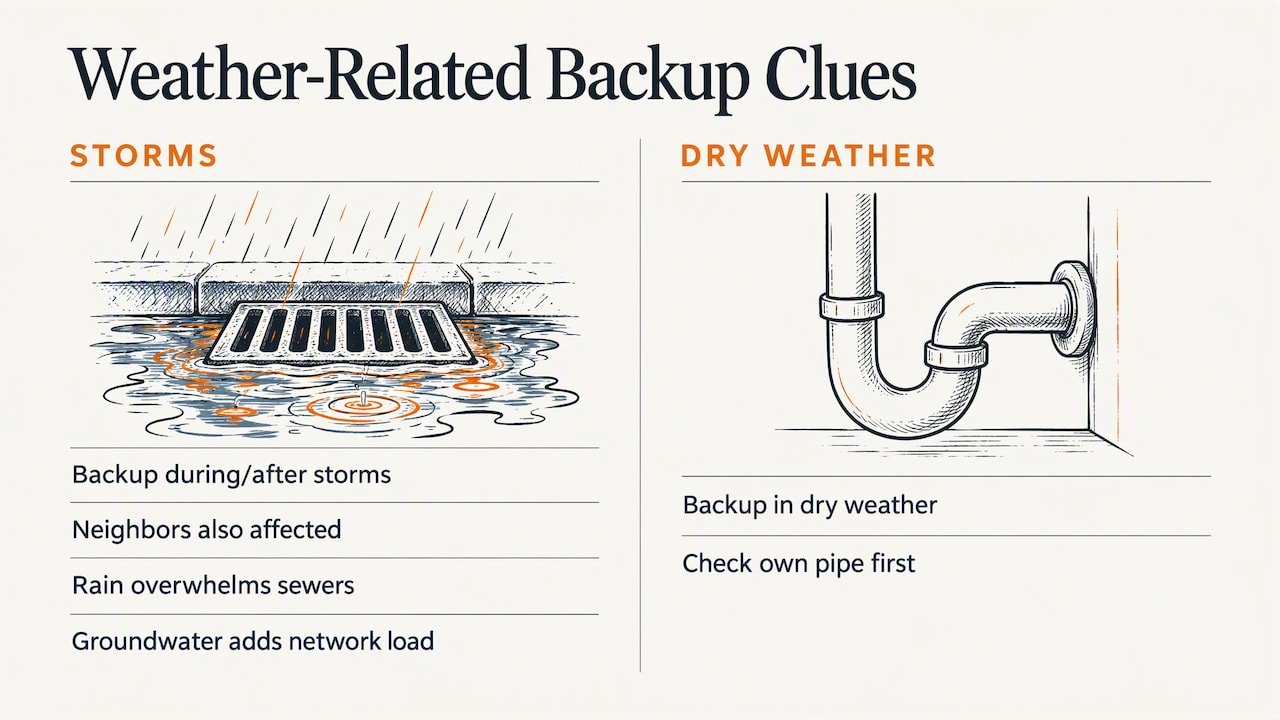
Sometimes the problem is not in your pipe at all. During long periods of heavy rain, sewers can be overwhelmed and unable to take water away quickly enough, and the same source notes that climate change is making this type of flooding more frequent. Groundwater can also get into public sewers and private drains through cracks in pipes or inspection chambers, usually during or after heavy rain, adding to the load.
A useful rule of thumb: if your backup arrives only in or after storms, and neighbors are affected too, the cause may be capacity in the wider network. If it happens in dry weather, look at your own pipe first.
Who is responsible: you or the water company?
This is the question that decides who you call and who pays, and it confuses most people.
Since October 2011, water companies have taken over ownership of private sewers. In practice, you are responsible for the drain that serves only your property, up to the point where it joins a neighbor’s pipe. Beyond that point, the water company is responsible. Coventry City Council describes the same split: shared sections and pipes outside your boundary that connect to the main sewers became Severn Trent’s responsibility in 2011.
That sounds tidy, but the boundary is invisible once the pipes are underground. Two houses with the same layout can have the shared point in different places, and you cannot tell by looking at the manhole.
| Where the blockage is | Who normally deals with it | What you should do |
|---|---|---|
| Inside the house (toilet trap, sink waste, internal pipe) | You | Call a drainage engineer or plumber |
| Your own drain, before it joins a neighbor’s | You | Call a drainage engineer |
| Shared drain or the pipe outside your boundary | Water company | Report it and get a reference number |
| Public sewer under the road | Water company | Report it immediately |
This is where a CCTV survey earns its fee. A camera run through the drain shows the blockage, its cause and its distance from the nearest manhole. With that footage you can see which side of the boundary the problem sits on, and it gives you something concrete to show the water company if they need to act. It also avoids the worst outcome: paying for work on a pipe that was never yours.
How a backup is found and cleared
Once the immediate danger is under control, the job has three parts: clearing the blockage, finding the cause and putting things right.
1. Clearing the line
For fat, wipes and silt, high-pressure water is usually the answer. Drain jetting uses a pressurized hose with a nozzle that scours the pipe wall and flushes debris on to the main sewer, rather than just punching a hole through it as rods can. For softer blockages in sinks and toilets, a smaller machine or a drain auger can be enough.
2. Finding the cause
Clearing the blockage only deals with today. A camera survey shows whether the line is clean and sound afterward: cracks, displaced joints, root ingress, sagging sections (known as bellied pipes) or a collapse. You get a recording and a plain explanation rather than guesswork. Our CCTV drain surveys are used for exactly this, and because we diagnose before we repair, we can avoid unnecessary digging.
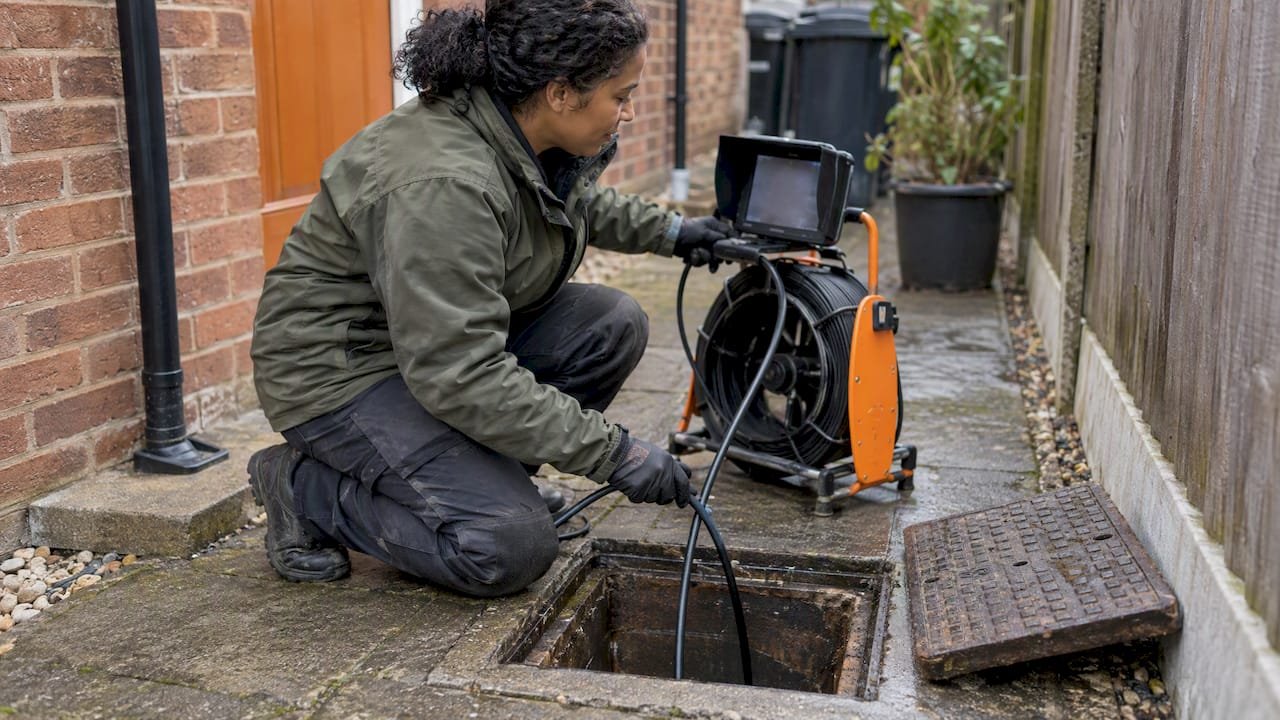
3. Repairing what the camera finds
Minor defects may need only a local repair. A broken section may need excavation or a lining repair, depending on access and the pipe’s condition. Either way, you should see the footage before agreeing to any work. More on our drain repairs is on our main page.
Cleaning up safely afterward
Only start cleaning once the source is stopped and the drain is flowing. Government guidance for floodwater applies equally well to a sewage escape.
- Protect yourself. Wear rubber boots, waterproof gloves, a plastic apron and eye protection, plus a face mask if cleaning is likely to cause a lot of splashing.
- Hard surfaces. Clean anything that touched the water with hot water and detergent, then disinfect, as the consumer advice from CCW also suggests.
- Textiles. Wash clothing and bedding on a 60°C cycle with detergent. Soft furnishings and carpets that have soaked up sewage are often not worth saving.
- Wash your hands with warm, clean water and soap. This is the most effective way to prevent infection after contact with floodwater or sewage.
Large escapes, sewage through floorboards or plasterboard, and anything in a rented flat or a commercial kitchen are best handed to a specialist cleaning firm. Tell your insurer early, and keep your photos and any water company reference number.
Your health
Contact with contaminated water can increase the risk of skin or gut infections. If you or a family member develops sickness, diarrhea or a skin problem after exposure, or you are simply worried, contact your GP or call NHS 111. Wash and cover any cuts before you start cleaning, and keep children out of the area until it is done.
The same guidance points out that most of the health burden linked to flooding in England comes from its effect on mental health and wellbeing. Sewage in your home is distressing, and asking for help is reasonable.
Perspective: what we see on call-outs
Most of the sewage backups we attend in Coventry feel like sudden disasters to the customer, but the drain has usually been warning them for weeks. A slow bath, a toilet that gurgles, a faint smell by the back door. Those are the cheap moments to act.
The second thing we see is people paying for the wrong thing. Someone has a drain jetted three times in a year when the real problem is a collapsed section or a root mass, and nobody ever put a camera in to check. That is why we survey first. If we can show you the pipe on screen, you can decide with full information, and often the answer is a smaller, less disruptive job than you feared.
The third is the question “whose drain is this?” It is worth asking before any work starts. If the footage shows the fault is beyond your boundary, you should report it to the water company with the evidence in hand rather than pay for it yourself.
For landlords and property managers, the lesson is the same but with a schedule attached. A drain that has blocked twice deserves a survey, and a drain serving a busy building deserves regular jetting. It is cheaper than an emergency and the tenant complaint that comes with it.
— Daniel
Need help with a backed-up drain in Coventry?
We are a local team covering Coventry, Nuneaton, Bedworth, Hinckley and the surrounding area. We clear blocked drains, toilets and sinks, carry out high-pressure jetting, and run CCTV surveys so you know what is wrong before anything is dug up. If sewage is already coming up, use our emergency call-out page or call 07446 170 620.
If the drain is slow but not yet overflowing, a CCTV drain survey is the calmest way to find out why. We also carry out drainage repairs in Nuneaton, and you can see examples of our work in our portfolio. We give clear advice with no pressure, and we do not publish fixed prices because every drain is different. We will explain the cost before work starts.
Preventing it from happening again
Prevention is mostly habit, plus a little maintenance.
- Bin the wipes. Only toilet paper and human waste go down the toilet. Wipes, cotton buds, sanitary products and nappies go in the bin.
- Keep fat out of the sink. Let cooking oil and fat cool, then put them in a container in the general waste. Wipe greasy pans with kitchen paper before washing.
- Fit strainers over kitchen sink and shower drains to catch food and hair.
- Know your trees. Large shrubs and trees close to a drain run are the usual source of roots. A survey every few years is sensible for older clay drains near mature trees.
- Schedule jetting for properties with a history of grease or silt build-up, such as takeaways, houses of multiple occupancy and some older homes.
- Consider a backwater valve. CCW suggests installing a backwater valve and keeping your pipes regularly maintained to help prevent future sewer flooding. A valve lets wastewater out but stops it flowing back. Have an engineer survey the drain first, as fitting depends on the layout of your pipes.
If you are buying a home, a drain survey before exchange can pick up root ingress, cracked pipes and poor falls that a general survey never sees. That is far cheaper than finding out after completion.
FAQ
Is sewage backing up an emergency?
Yes, if wastewater is inside the property or you cannot use the toilets. Keep people away, switch off electricity if water is near it, and stop using water. Then report it to your water company and call a drainage engineer for fast clearing.
Can I clean up sewage myself?
You can handle a small spill once the source is cleared, using gloves, boots, eye protection, hot water and detergent. Large escapes, or sewage that has soaked into floors and walls, should be left to professionals. See your GP or NHS 111 if you feel unwell afterward.
Who pays when sewage backs up in my house?
It depends on where the blockage sits. The water company deals with public sewers and the shared or outside-boundary pipes it took over in 2011. You are responsible for the drain serving only your home. A CCTV survey shows which side of the line the fault is on.
Why does sewage back up when it rains?
Heavy rain can overload public sewers, and groundwater can seep into cracked pipes and chambers. If it only happens in storms and your neighbors are affected too, report it to the water company. Your own drain may still be worth surveying for cracks that let water in.
How do I stop sewage backing up again?
Keep wipes, fat and oil out of the drains, clear tree roots and repair damaged pipes. A camera survey tells you what condition the line is in. A backwater valve may help where the problem comes from the sewer.
Sources
- Guide to sewer flooding, Severn Trent
- Causes of sewer flooding, Severn Trent
- Causes of sewer flooding, Wessex Water
- Blockages and blocked drains, Thames Water
- What to do during sewer flooding, Thames Water
- Sewer flooding, what to do if your home is affected, CCW
- Flooding and health: advice for the public, GOV.UK
- How to recover from flooding, GOV.UK
- Plumbing and drainage misconnections, Water UK
- Flood reporting, Coventry City Council
Trackbacks/Pingbacks