
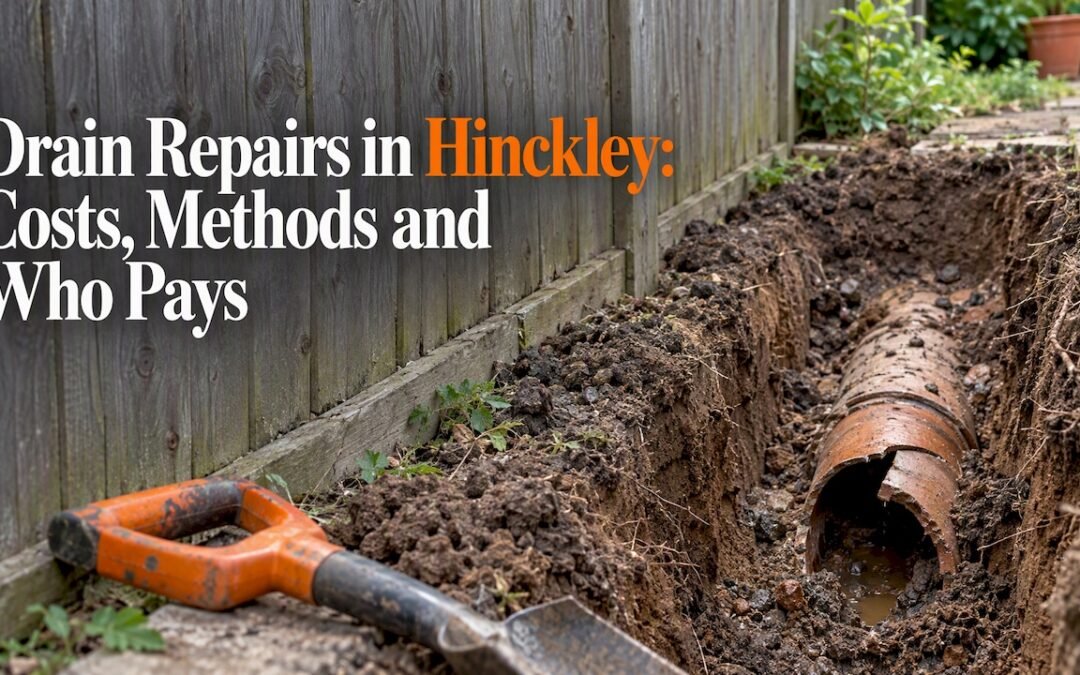
If a drain in Hinckley keeps blocking, smells, or has started to back up, the first job is to find out whose drain it is and what is actually wrong with it. A drain that only needs unblocking is a quick fix. A cracked, displaced or root-invaded pipe needs a repair, and a camera survey is the reliable way to tell the two apart. We cover Hinckley and the wider Coventry area, and this guide explains how the process works, who is responsible, what affects the price and what to do before you call anyone.
TL;DR
- Check ownership first: you look after the pipes that serve only your property inside your boundary, while Severn Trent Water handles shared pipes and public sewers.
- A drain that blocks again and again within weeks usually has a structural fault, and a CCTV survey shows what it is before any digging.
- Repairs range from patch lining and full relining to excavation, and the right one depends on the camera footage.
- Price depends on access, depth, length of pipe, repair method and whether the problem is urgent, so ask for a quote based on footage, not a guess.
- If sewage is coming into your home or garden, act at once and contact Severn Trent, which runs a 24-hour line.
Table of Contents
- Does your drain need repairing or just unblocking?
- Who is responsible for a drain in Hinckley?
- What to do first if a drain is overflowing
- How CCTV finds the fault before anyone digs
- Drain repair methods and when each is used
- What drain repairs cost in Hinckley
- Our perspective on drain repairs
- Keeping drains healthy between repairs
- Book a drain repair or survey in Hinckley
- FAQ
- Sources
Does your drain need repairing or just unblocking?
Unblocking removes something sitting in the pipe: grease, wipes, paper, a build-up of silt. Repair deals with the pipe itself. The distinction matters because paying repeatedly for clearance when the pipe is broken is the most common way homeowners waste money on drains.
Signs that point to a blockage that clears once:
- A single sink, toilet or gully is slow, and the rest of the house drains normally.
- The problem began suddenly, for example after a heavy meal prep, a nappy or wipe going down the toilet, or a builder’s work.
- Jetting or rodding clears it and it stays clear for months.
Signs that point to a defect worth investigating:
- The same drain blocks again within weeks of being cleared.
- You hear gurgling from several fittings at once, or a toilet bubbles when the washing machine empties.
- There are damp patches, sunken paving or a lawn that is greener or boggy along a straight line, which can mean a leak.
- A persistent sewage smell outside, near a manhole or gully, with no visible blockage.
- Rats or other signs of pests around a manhole, which can follow broken pipework.
- A manhole that overflows when other homes nearby are fine.
Cracks, offset joints, collapsed sections and tree roots finding their way in at a joint all cause repeat blockages. Fat and debris catch on the damaged edge, and every clearance is only temporary. If you recognize the second list, ask for a survey rather than another unblocking visit. Our CCTV drain survey puts a camera in the pipe so the fault is seen, recorded and explained before any decision about repair.
Who is responsible for a drain in Hinckley?
Before you pay for any repair, establish who owns the section that has failed. Hinckley & Bosworth Borough Council explains that Severn Trent Water is responsible for sewerage outside your property boundary and for drains within the boundary that are shared with another property. Owners stay responsible for pipes within their boundary that serve only their own property.
In practice, that gives you three situations:
| Type of drain | Who is usually responsible | What to do |
|---|---|---|
| Pipe serving only your property, inside your boundary | You, as the owner | Arrange a survey and repair through a drainage contractor |
| Pipe shared with a neighbor, or running outside your boundary | Severn Trent Water | Report it to Severn Trent |
| Road drains and gullies | Leicestershire County Council | Report blocked or flooding road drains to its Highways Department |
The council’s page on road drainage confirms that road drainage sits with Leicestershire County Council. The council itself does not clear a domestic blockage where the pipe is within the boundary and serves only that property. It also says it may take legal action to make sure blockages are cleared and repairs are done by whoever is responsible, so leaving a known fault alone is not a safe option, particularly for landlords and property managers.
If you are unsure which category you fall into, a camera survey helps here too. Footage shows where your private pipe joins another or leaves the property, which makes the conversation with Severn Trent much more precise. For a deeper look at how the process runs, the NHIC drainage survey digest describes a survey as mapping layout, ownership, depth, flow direction, pipe dimensions and condition.
What to do first if a drain is overflowing
A backing-up drain or a flooding manhole is a different situation from a slow sink. Work through these steps in order:
- Stop adding water. Hold off on the washing machine, dishwasher, showers and flushing.
- Keep people and pets away from any sewage, and wear waterproof gloves if you must go near it. Wash your hands thoroughly afterwards.
- Look at the nearest manholes. If the one at your boundary is full and others nearby are too, the problem may be in the shared sewer.
- If you think it is a public sewer problem, phone Severn Trent. It says it is open 24 hours a day, seven days a week, to help work out what caused sewer flooding and will arrange a visit if the cause cannot be found over the phone.
- If the blockage is in your own pipe, call a drainage contractor. Our emergency call-outs cover urgent backups in Hinckley and the surrounding area, and you can also read what to expect in our guide to an emergency drain service.
Take photographs of any flooding for your records. They help if you need to talk to your insurer or to the water company.
How CCTV finds the fault before anyone digs
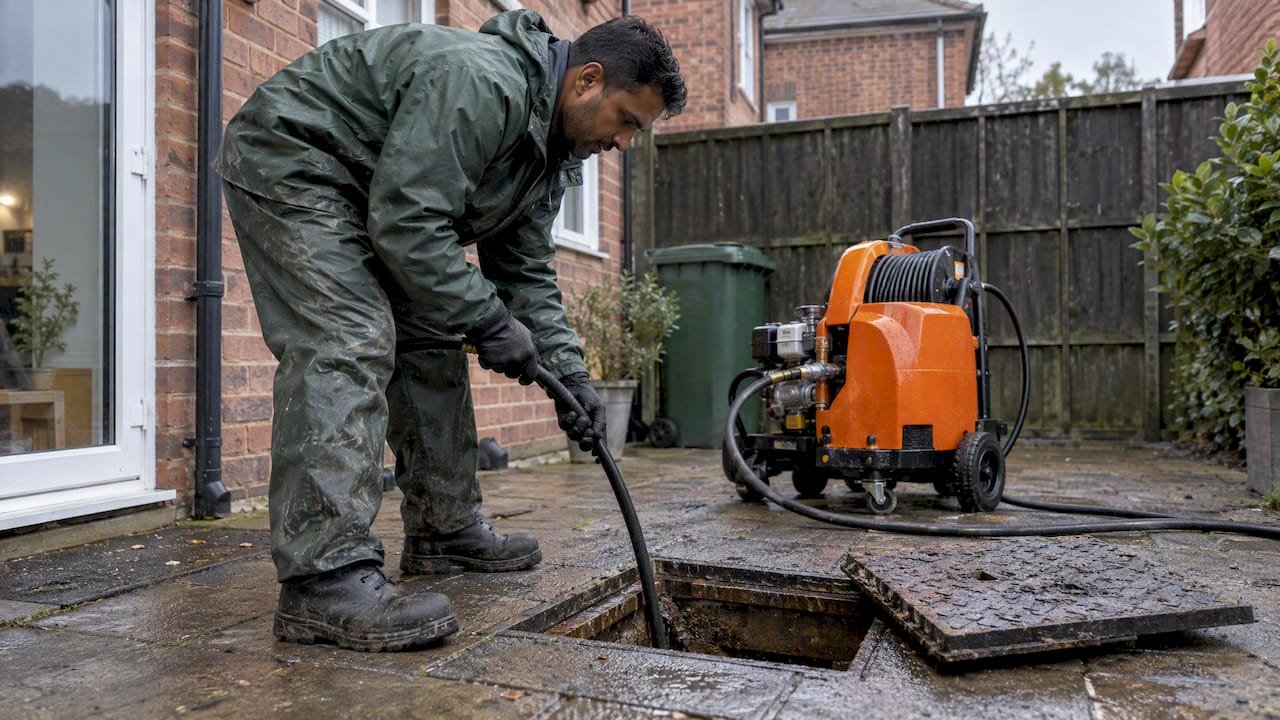
A drainage engineer feeds a waterproof camera on a flexible rod into the pipe through a manhole, gully or inspection point. The footage runs live to a screen and is recorded. The engineer can then see cracks, displaced joints, roots, scale, sags in the pipe and collapsed sections, and measure how far along the pipe each defect sits.
That last point is what saves money. Without a camera, a repair quote depends on guesswork, and the worst-case guess is a trench across your garden or drive. With footage, the work can often be limited to the section that has actually failed. The NHIC digest notes that a survey recording layout, depth, condition and ownership is useful before an extension or other building work, because it shows if you are building over or near a pipe.
A fair account of the technique also includes its limits. Academic guidance on asset inspection notes that CCTV is limited to visible features on the pipe’s inner surface and cannot see below the water line. This is why a good engineer will often jet or clear the line first, so that standing water or debris does not hide a defect, and then film it again.
Surveys are also worth having in these situations:
- Buying a house. A home buyer drain survey shows the condition of the drains before you commit, so a collapsed pipe does not become your bill after completion. We offer these through the same CCTV drain surveys page.
- Recurring blockages. If clearing keeps failing, footage shows the cause.
- Before building work. Extensions, conservatories and driveways can sit over or near drains.
- Landlords and property managers. A recorded survey gives you evidence of condition for a tenancy, an insurance query or a maintenance plan.
Drain repair methods and when each is used
The camera footage decides the method. In broad terms, there are three families of repair, and a reputable contractor will explain why they recommend one over another.
Patch repairs
A patch, sometimes called a spot repair, treats a single localized defect such as a crack, a hole or a slightly open joint. A resin-soaked liner is positioned over the damage from inside the pipe and left to harden. No trench is needed in most cases. It suits a pipe that is otherwise sound.
Relining
Relining places a resin-impregnated liner along a longer run of pipe, forming a new pipe inside the old one. It suits pipes with multiple defects, cracking along their length or several poor joints, where patching each fault would be impractical. It is usually done through existing access points, so gardens, patios and drives stay largely intact. It is not suitable for every pipe: a badly collapsed or heavily misaligned section generally cannot be relined, and the engineer will want to see the footage before agreeing it will work.
Excavation and replacement
When a pipe has collapsed, is badly displaced, has a severe sag or has been crushed by heavy loads, the damaged section often has to be dug up and replaced. Footage lets the engineer locate it precisely, so the trench can be as short as possible. Old clay pipes with failed joints and pitch-fibre pipes that have deformed are common candidates.
Root removal
Roots enter at joints and cracks, then grow into dense mats that block the flow. Cutting them out clears the pipe, but unless the entry point is sealed or lined, they will return. We cover this on our root removal page, and the survey footage shows whether a repair is needed to stop regrowth.
Clearing first: jetting
High-pressure water jetting scours grease, scale and silt off the pipe walls. It is often the step before a survey or repair, since a clean pipe gives a clear picture and a better bond for lining. See our high-pressure jetting service for how it works.
What drain repairs cost in Hinckley
We do not publish fixed prices for repairs, and for good reason: two drains that look alike from the surface can need completely different work. What we can tell you is what moves the price, so that any quote you receive can be compared fairly.
- The repair method. A patch is generally a smaller job than a full-length reline, and either is generally less disruptive than a dig.
- Length of pipe affected. One defect or several along a run.
- Depth and access. A shallow pipe next to a manhole is easier than a deep one under a conservatory or a mature tree.
- Surface reinstatement. Digging up block paving, a patio or tarmac adds work on top of the drain repair itself.
- Urgency. Out-of-hours or emergency attendance costs more than a booked slot.
- Whether a survey is needed first. Most repairs begin with footage, because the quote is only as good as the diagnosis.
A useful benchmark for the simplest case is the water company’s own charge. Severn Trent states that it can clear a blockage in a homeowner’s drain for £114 including VAT, and customers are under no obligation to use it. That covers clearance only, not repair of a damaged pipe. Anything structural is priced on the footage.
When you compare quotes, check that each one says which section of pipe is being repaired, by what method, and whether reinstatement of the surface is included. A quote that just says “drain repair” with a single figure is hard to hold anyone to. Ask for a copy of the footage too: a contractor who is confident in their diagnosis will happily share it.
Our perspective on drain repairs
Most of the call-outs we see in Coventry and the towns around it, Hinckley included, follow the same pattern. A homeowner has paid to have the drain cleared two or three times, the problem keeps returning, and nobody has ever looked inside the pipe.
We believe the camera comes first. Our approach is built on diagnosing the fault with CCTV before any repair begins, so you see the same footage we do, you understand what is wrong, and the work is limited to what the pipe really needs. That is how we aim to avoid unnecessary digging and disruption.
We also think advice should come without pressure. If your blockage is a simple one, we will say so. If it is a defect, we will show you where it is and explain the options in plain language, then you decide. Local engineers, quick response for emergencies and clear pricing are the things we hold ourselves to.
If a drain on your property has been misbehaving, do not wait for a flooded garden or a backed-up toilet. A survey costs far less in time and stress than an emergency.
Daniel
Keeping drains healthy between repairs
Maintenance will not fix a broken pipe, but it does reduce the number of blockages in a sound one. The habits that make the biggest difference are simple.
- Bin the wipes. Wet wipes, even those labeled flushable, nappies, sanitary products and cotton buds do not break down the way toilet paper does.
- Keep fat out of the sink. Cooking oil and grease cool and coat the pipe wall. Wipe pans with kitchen paper before washing.
- Use strainers. Hair and food scraps are cheaper to catch in a plug strainer than to clear from a trap.
- Keep gullies clear. Leaves and silt in outdoor gullies wash into the drain. Check them in autumn.
- Watch trees and shrubs. Roots look for moisture. Planting thirsty species close to a drain run invites trouble.
- Schedule jetting if your property is a repeat case. Restaurants, takeaways, rental blocks and older properties with scaled pipes often benefit from planned cleaning rather than waiting for a blockage.
- Do not ignore early warnings. Gurgling, slow drainage and smells are cheaper to deal with now than after a backup.
Landlords and property managers can go a step further: a survey when a tenancy begins or a building is taken on creates a record of condition, and a regular jetting schedule on problem drains keeps call-outs predictable.
Drains under driveways and paving
Many drain faults surface when a drive or patio is being laid or relaid, because pipes sit just beneath the surface and can be cracked by heavy vehicles or poor compaction. If you are planning surface work, have the drains surveyed first, and make sure the contractor plans for drainage as well as the finish. Driveway drainage planning is worth settling before the surface goes down, because digging up a new drive to reach a failed pipe is expensive for everyone.
Book a drain repair or survey in Hinckley
We are a local drainage company serving Hinckley, Nuneaton, Coventry and the surrounding area. We carry out drain unblocking, high-pressure jetting, CCTV surveys, home buyer surveys, root removal and drain repairs, and we respond to emergencies. Our aim is to look inside the pipe first, explain what we find and keep any digging to a minimum.
To discuss a problem, visit our drain repairs page or call 07446 170 620. If it is urgent, use our emergency call-out service. Neighboring areas have their own pages too, including Nuneaton and Coventry.
FAQ
Who pays for a drain repair in Hinckley?
It depends on whose pipe it is. The owner pays for pipes inside the boundary that serve only their property. Severn Trent Water is responsible for shared drains and sewers outside the boundary, and Leicestershire County Council is responsible for road drainage. If you are not sure, a CCTV survey can show where your pipe ends and a shared one begins.
How much does a drain repair cost?
There is no single figure, because the price depends on the method, the length of pipe, the depth, the surface that needs reinstating and how urgent the job is. Simple clearance is cheaper than structural repair. Ask for a quote based on survey footage and make sure it states what is included.
Can a drain be repaired without digging up my garden?
Often, yes. Patch lining and relining work from inside the pipe through existing access points. Digging is generally reserved for collapsed, badly displaced or crushed sections. The camera footage tells the engineer which applies to your drain.
Is a blocked drain an emergency?
A single slow sink usually is not. Sewage backing up into your home, a flooding manhole or a toilet that will not flush with other fittings affected are urgent. Stop using water, keep clear of the sewage and call a drainage contractor, or Severn Trent if the problem looks like a public sewer.
Should I get a drain survey when buying a house in Hinckley?
It is a sensible step, particularly for older properties or those with trees nearby. A survey shows the condition of the drains and whether any repairs are needed, so you can factor them into your offer. It also records the layout, which helps if you plan an extension later.
Sources
- Drains: who is responsible, Hinckley & Bosworth Borough Council
- The council’s enforcement procedures, Hinckley & Bosworth Borough Council
- Guide to sewer flooding, Severn Trent
- Helping you deal with sewer problems, Severn Trent
- Private Sewers and Drain Surveys digest, NHIC
- Investigate the condition of an asset, White Rose research