
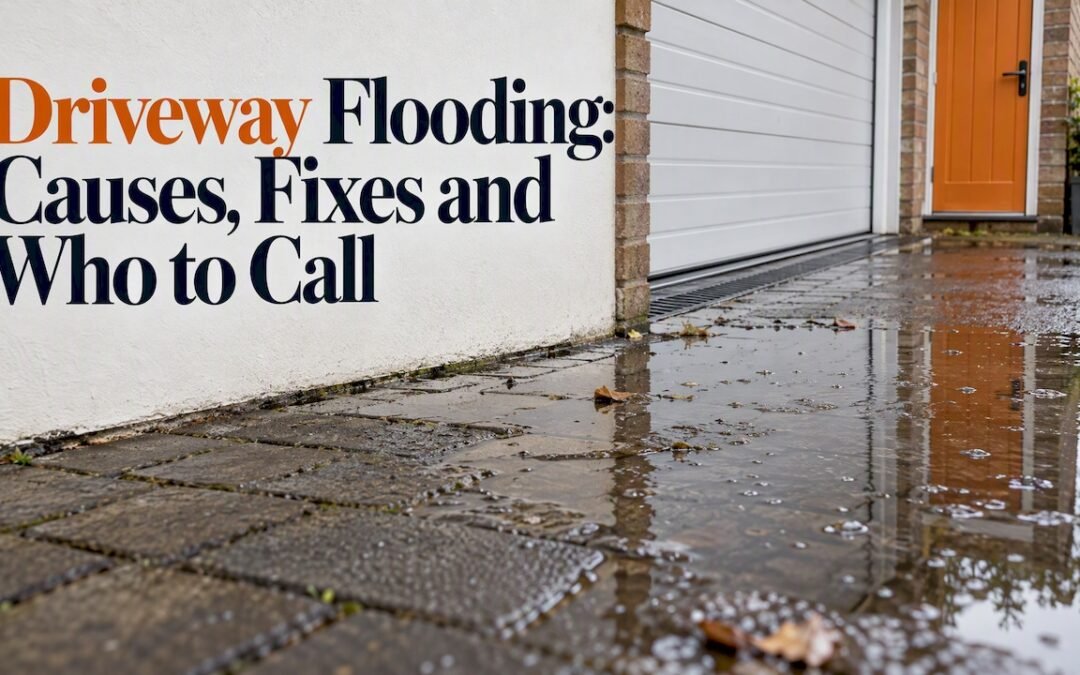
A driveway floods for one of three reasons: the surface sends water the wrong way, the drain meant to take it is blocked or broken, or the ground and sewers nearby simply can’t cope with the rain. The quickest way to tell which one you have is to watch where the water goes during a downpour, then check what happens at the drain. If it sits above a gully or channel, the drain is the likely culprit. If there is no drain, it is a surface and drainage design problem.
This guide walks through the causes, the immediate steps to protect your home, the permanent fixes, the UK rules that apply, and how we find hidden drain faults without digging up your drive.
TL;DR
- Driveway flooding usually comes from a blocked or collapsed drain, a surface that slopes toward the house, or hard paving that gives rain nowhere to go.
- If water is heading for your front door, protect the home first: move valuables, block entry points and call 999 only if life is in danger.
- A CCTV drain survey shows what is happening underground, so you pay for the right repair and avoid unnecessary digging.
- Permanent fixes include permeable surfacing, a soakaway or rain garden, a channel drain, and clearing gutters and downpipes twice a year.
- Impermeable drives over five square metres that don’t drain to a permeable area need planning permission, and water must never be directed toward a neighbor.
Table of Contents
- Why your driveway floods
- What to do while it’s happening
- Working out the cause yourself
- Finding hidden drain faults without digging
- Permanent fixes for a flooding driveway
- The rules that apply in England
- Keeping it from coming back
- Our perspective
- Get your driveway drained properly
- FAQ
- Sources
Why your driveway floods
Most standing water on a drive has an ordinary explanation. Here are the common ones, roughly in the order we meet them in Coventry and Warwickshire.
A blocked or failing drain
Many driveways have a gully, channel or small manhole that takes surface water into a drain. Leaves, silt, gravel and grease build up inside. In heavy rain the pipe can’t carry the flow, and the water backs up through the grate and across the drive. Tree roots add to the problem, since they find their way into joints in older clay and concrete pipes and catch debris.
A collapsed or displaced pipe section does the same job with more permanent effect. You may see water drain slowly after rain stops, or a dip forming in the paving over the pipe run.
Rain from the roof with nowhere to go
A large roof area sheds a lot of water in a short time. If downpipes discharge onto the driveway, or the gutters overflow because they are full of moss and leaves, the drive takes the load. Gutter guidance from a conservation charity advises clearing gutters twice a year, in spring and autumn, since overflow water can sit on walkways and driveways and create a slip hazard.
The wrong slope
A drive that falls toward the garage or the house will hold water against the building. Settlement over the years can also create dips, particularly with block paving laid on a poor sub-base. If water pools in the same spot every time it rains, even light rain, the level of the surface is the likely cause.
Hard surfacing everywhere
Paving over a front garden removes the soil that used to absorb rain. Guidance from the paving industry notes that one small area of paving rarely causes major flooding, but the combined effect of many gardens being sealed creates real problems for the drains downstream. If your whole street has been paved, the local network is working harder than it was designed to.
Public sewer or surface water capacity
Sometimes the problem is beyond your boundary. In Coventry, Severn Trent Water owns and manages the public foul and surface water sewers, so an overflowing public sewer is theirs to deal with. Waste water pipes within your boundary that serve only your property are your responsibility, while the council’s flood reporting page explains that shared sections and pipes outside your boundary that connect to the sewer have been Severn Trent’s responsibility since a change in law in October 2011.
What to do while it’s happening
When water is coming up or pooling fast, work through this order.
- Check for danger to life. The official advice from Natural Resources Wales is to call 999 if anyone is in immediate danger.
- Protect the house. The same guidance suggests moving valuables to a higher level, switching off utilities if it is safe to do so, and blocking doorways with items such as pillowcases filled with soil.
- Look at where the water is coming from. Clear water from the sky and roof is a surface issue. Water that smells, is grey or contains toilet paper is sewage, and that is a different emergency. If foul water is coming up in the house, read our page on what to do when sewage is backing up.
- Report public sewer problems. If the problem looks like it comes from a sewer in the road, contact your water company. In Coventry, that is Severn Trent.
- Call a drainage engineer for private drains. If the water is rising at a gully on your own land, the fault is yours to sort out, and we offer emergency call-outs across Coventry and the surrounding area.
Do not clear a flooded drain by pouring chemicals down it. They rarely shift a root or a collapsed pipe, and they make working on the drain afterward less pleasant for whoever has to do it.
Working out the cause yourself
You can narrow things down in ten minutes with a dry run and a hose, or better, by watching during real rain.
| What you see | Likely cause | Next step |
|---|---|---|
| Water rises through a gully or grate and drains slowly after rain stops | Blocked or partially collapsed drain | Jetting, then a CCTV survey |
| Water spreads from one dip in the surface | Settlement or poor falls | Re-lay or re-level the area, add a drain |
| Water runs from downpipes straight onto the drive | Roof water with no outlet | Connect downpipes to a drain or soakaway |
| Whole drive wet, no drain anywhere | Impermeable surface, no drainage design | Permeable surfacing or channel drain with soakaway |
| Water backs up in several places at once, including inside | Shared or public sewer overloaded | Report to the water company, call us to check your own pipes |
| Foul smell or toilet paper | Sewage backup | Treat as an emergency |
If your drive has a drain and still floods, the fault is almost always underground, and that is where a survey earns its fee.
Finding hidden drain faults without digging
Guessing at a drain problem is expensive. Digging a trench along a likely line can mean lifting block paving, cutting tarmac and living with the mess, only to find the pipe is fine ten feet away.
A CCTV drain survey sends a small camera through the pipe, so we can see roots, cracks, displaced joints, collapses, scale and build-up on a screen. You see the footage too, which means you are fully informed before any repair begins. It also lets us pinpoint the depth and position of a fault so that, if a repair is needed, the excavation is as small as it can be.
The survey usually follows a first clean. High-pressure jetting uses water at pressure to clear silt, grease and debris from the pipe walls, which often cures slow drainage on the spot. The camera then checks that the pipe is sound underneath. If roots are the problem, we also offer root removal from the drain.
We don’t publish fixed prices for these services, because the cost depends on the length of the run, access and what is found. We give you clear pricing and no-pressure advice before any work begins.
Permanent fixes for a flooding driveway
Once the drain is clear and sound, the next step is making sure the drive can cope with heavy rain in future. Which fix suits you depends on what you have and how much space there is.
Permeable surfacing
Council guidance lists gravel, permeable concrete block paving and porous asphalt as permeable options that let water soak into the ground. It also notes that drives steeper than 1 in 20 may not suit permeable surfacing, and that contaminated sites may need drainage connections or specialist construction. If your drive is steep or on heavy clay, get the ground assessed before choosing a surface.
A border, rain garden or soakaway
An existing hard drive can stay if the water is sent somewhere sensible. Peterborough City Council’s homeowner guide lists directing runoff from an impermeable surface to a border rain garden or soakaway among the common solutions, alongside gravel and vegetated areas. A soakaway only works if the soil underneath drains. Clay-heavy ground, common across much of the Midlands, can make a soakaway slow, so test it first and don’t build one close to your foundations.
A channel drain across the drive
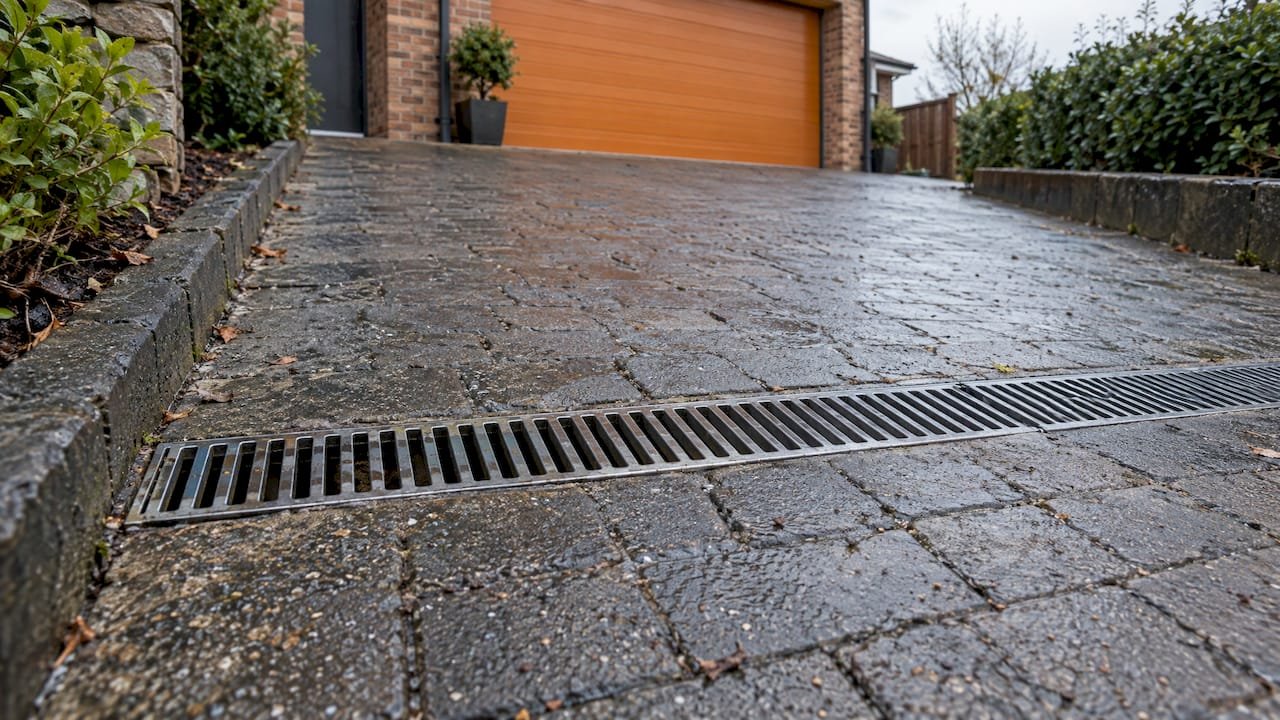
A linear channel drain set across the bottom of a sloping drive intercepts water before it reaches the garage door. It needs somewhere to discharge: a soakaway, a rain garden or a connection to a suitable drain. A channel with no outlet only moves the puddle. It is also not always the answer. If the real fault is a blocked pipe downstream, a new channel just fills faster.
Re-grading the surface
If the drive falls toward the house, the fix is to alter the levels so that it falls away, usually combined with one of the options above. This is a groundworks job, and the pipe runs beneath the area should be surveyed first so nothing gets damaged or buried.
Sorting the roof water
Check that gutters aren’t leaking at joints and that downpipes connect to a drain, not onto the drive. This is the cheapest improvement of the lot and is often overlooked.
The rules that apply in England
Two rules matter before you change a drive.
First, planning. The Planning Portal states that you won’t need planning permission if a new or replacement driveway uses permeable surfacing, or if rainwater is directed to a lawn or border to drain naturally. Where more than five square metres is covered with traditional impermeable paving that doesn’t drain to a permeable area, planning permission is needed. Some properties have conditions or an Article 4 Direction that limit these rights, so check with your local planning authority before starting, especially if you are in a conservation area.
Second, your neighbors. Government guidance on front garden surfacing says water should not be directed toward a neighbor’s property. If your drive slopes toward the boundary, solve it on your side. If a neighbor’s drive is sending water onto yours, a friendly conversation and photographs of the problem during rain are the best first step. Landlords and property managers should keep the same records for tenants’ reports.
Keeping it from coming back
Driveway drainage fails slowly and then all at once. A small routine prevents most call-outs.
- Clear gutters and downpipes in spring and autumn. Leaves from autumn are the usual cause of overflow in the first heavy rain.
- Keep grates and gullies clear. Local authority advice from Canada suggests clearing eavestroughs, downspouts and nearby catch basins of leaves and debris and directing downspouts away from your foundation and the neighbor’s property. The principle applies equally here.
- Brush permeable surfaces. Clear leaves, mud and litter, and brush the surface to reduce clogging and stop weeds, as the front garden surfacing guidance recommends.
- Watch trees near drains. If roots have found a pipe once, they return. Periodic jetting or a camera check keeps it from escalating.
- After a flood, clean up carefully. The RHS advises washing down hard surfaces and collecting debris afterward, and keeping off soil until it is workable to avoid compaction in planted borders.
- Book a check before winter. For landlords and property managers with several properties, a scheduled jetting and survey visit before the wet season is cheaper than an emergency.
Our perspective
Most driveway flooding calls we get start with a guess: the owner thinks the drain is blocked, or a neighbor’s drive is to blame, or the paving needs replacing. Sometimes they are right. Often the real fault is somewhere nobody has looked.
That is why we put the camera in first. A CCTV survey takes the guesswork out of the job, shows you exactly what is wrong and where, and lets you decide on a repair with the footage in front of you. In our experience that is the difference between a small, targeted fix and a trench across the whole drive.
We are local engineers working across Coventry, Nuneaton, Warwickshire and Hinckley, so when water is heading for your front door we aim to respond quickly. We explain the problem plainly, give you clear pricing, and never push you toward work you don’t need. Jetting, root removal, surveys and repairs are all things we do every week, so we can usually move from diagnosis to fix without bringing in a second company.
Daniel
Get your driveway drained properly
If your driveway keeps flooding, we can clear the drain, put a camera down it and tell you plainly what is wrong before you commit to any repair. We cover homes and businesses in Coventry and the surrounding area, including Nuneaton, Warwick and Leamington.

For a drive that is flooding right now, start with our emergency call-out service. For recurring puddles, book a CCTV drain survey, or see the work we have done on our portfolio page. Our Coventry drainage repairs page has the details for local jobs.
FAQ
Why does water pool on my driveway after every rain?
Usually because the surface has a dip, the slope runs the wrong way, or the drain serving it is partly blocked. If the water takes hours to disappear after the rain stops, suspect the drain. A jetting visit and camera survey will confirm it.
Is a flooded driveway my responsibility or the water company’s?
Pipes within your boundary that serve only your property are yours. In Coventry, Severn Trent Water is responsible for public sewers and for shared sections and connecting pipes outside the boundary, according to the council’s flood reporting page. If you aren’t sure, a CCTV survey shows where the pipe runs and where the fault sits.
Do I need planning permission to fix my driveway drainage?
Not for a permeable surface, or for a hard surface that drains to a lawn or border. A new impermeable drive of more than five square metres that doesn’t drain to a permeable area does need permission. Check any local restrictions with your planning authority first.
Can I stop water running onto my neighbor’s property?
Yes, and you should. Guidance says water must not be directed toward a neighbor’s land. A channel drain, soakaway or re-graded surface keeps runoff on your side, and a survey of the pipes first avoids surprises.
Will a drainage engineer have to dig up my whole drive?
Not usually. We start with jetting and a camera survey, which shows the exact position and depth of any fault. If a repair is needed, the digging is limited to that spot.
Sources
- Flood reporting, Coventry City Council
- Planning permission: paving your front garden, Planning Portal
- Guidance on the permeable surfacing of front gardens
- SuDS for homeowners, Peterborough City Council
- What to do in a flood, Natural Resources Wales
- Rainwater and paving, paving.org.uk
- Keeping your gutters clear
- Essential outdoor cleaning tips to prevent flooding, City of Mississauga
- Waterlogging and flooding solutions, RHS